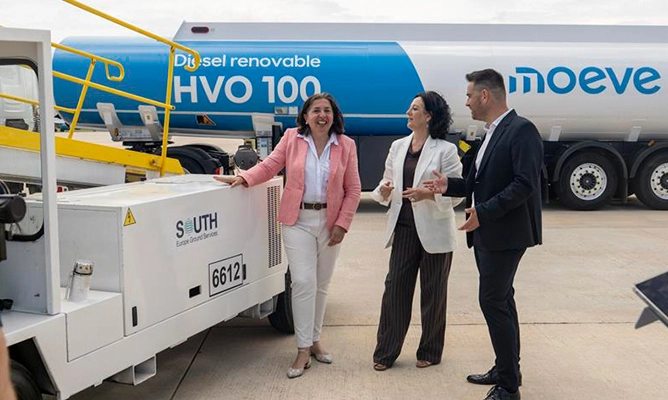
South bets on renewable HVO 100 MAX diesel Moeve
The IAG Group's handling company uses this biofuel in its ground support equipment at several Spanish airports.
The road to the decarbonization of land transportation
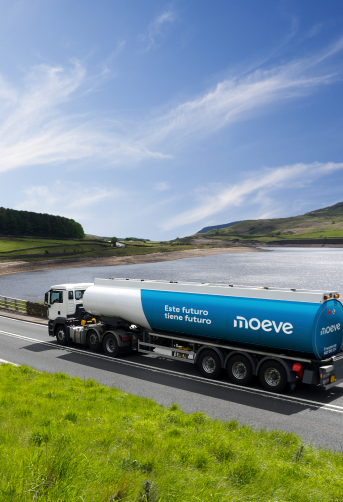
A second-generation biofuel obtained through oil and fat hydroprocessing.

Save in maintenance costs and optimize the fuel consumption thanks to fewer deposits forming inside the engine compared to conventional diesel.

It's produced from circular raw materials, such as used cooking oil and agricultural waste, which are given a second life.

It can reduce CO₂ emissions by up to 90% throughout the life cycle, compared to fossil fuels.

It can be used in existing engines without requiring any modifications to them or to fuel storage infrastructure.
It can completely replace traditional diesel but can also be mixed.
Access or download our information dossier and technical sheet.


Information dossier
Information dossierEffective for sectors that are difficult to electrify.
 Ground transportation
For both heavy road transport and rail transport.
Find out morearrow_right_alt Sea transport
Valid for all types of vessels.
Find out morearrow_right_alt Agricultural machinery
Perfect for use in agricultural vehicles.
Find out morearrow_right_alt
The IAG Group's handling company uses this biofuel in its ground support equipment at several Spanish airports.

We’re doubling our production capacity in partnership with Bio-Oils.

We deliver directly to our customers' installations.

Along with Maersk and Renfe, we’ve used more than 130 tons of HVO 100 on the Algeciras-Cordoba route.

HVO 100 stands for Hydrotreated Vegetable Oil 100: vegetable oil treated with 100% diluted hydrogen.
From agricultural or livestock waste that has been previously treated to remove impurities. These materials are refined through a process called hydrodeoxygenation, which removes oxygen, sulfur and nitrogen from these renewable raw materials.
HVO 100 renewable diesel can cut CO₂ emissions by up to 90% over its entire life cycle compared to conventional fossil fuels. Moreover, it's produced from organic waste, which promotes the circular economy.
This biofuel is chemically similar to the fossil fuel used in vehicle engines such as trucks and ships.
As a result, it can replace up to 100% of traditional diesel without having to modify current engines.